

NOBODY is on schedule
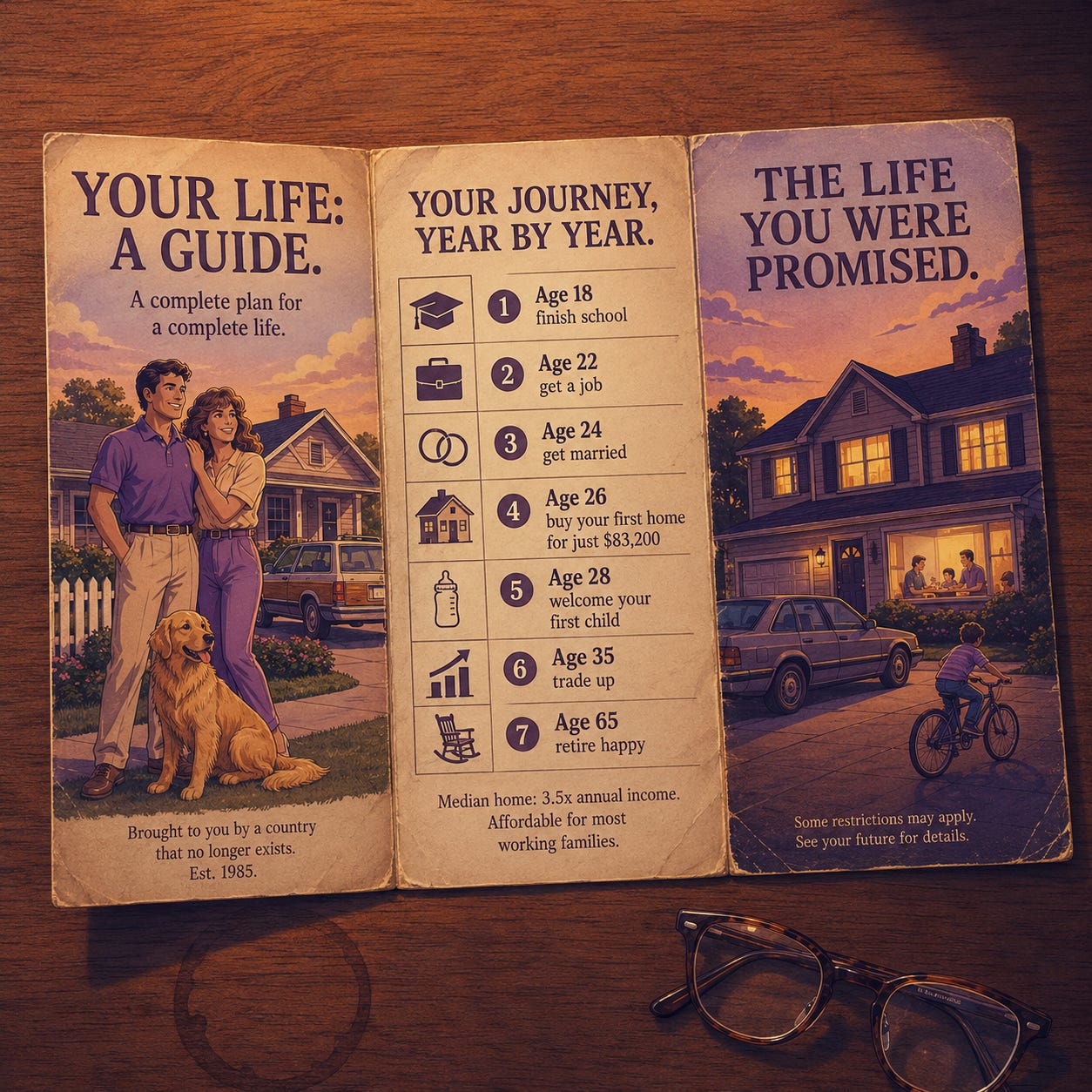
The brochure is from a country that no longer exists

Somebody you grew up with bought a house this week.
You saw it on Instagram. The kitchen island. The dog by the door. His wife with one hand on her stomach in the third photo.
You typed congrats and you meant it.
You also felt something heavy you didn’t have words for.
Underneath the congrats was the same question that’s been hovering over a lot of your weeks lately.
Am I behind???
You closed the app. You went to bed with the question. You woke up with it. It’s been the quiet hum underneath most of your decisions for a while now.
Here’s something that took me too long to figure out.
The schedule is broken.
The brochure we grew up with
We grew up with a brochure.
Finish school → Get a job → Buy a house in your late 20s → Marry → Have a kid or 2 → Trade up → Retire happy :)
We saw it in our parents. We saw it in our grandparents. We saw it in every TV show our entire childhood. By 30, you have the house, the spouse, the dog, the second car, the baby seat in the back.
Here’s the part you can feel in your chest before I tell you the data.
The brochure is from a country that no longer exists.
In 1985, the median Canadian home cost about 3-4x annual household income. When my dad was buying his first place, that math was hard, but it was math you could do.
Today, that ratio sits closer to 7-10x income, depending on the city. In 2022, in the hottest Canadian markets, it spiked as high as 16x. The mortgage payment on the median home in Canada now eats up over half of the median household income (in the US, the price to income ratio is around 5.5, the highest reading there in over 100 years).
The typical first time home buyer in Canada was 29 in the 1970s and 80s. Today, the typical first time buyer in Toronto is around 40. In Montreal, 39. In Vancouver, 46 (in the US, the typical first time buyer is now 40, up from 30 in 2010).
In a generation, the front door of adulthood moved 10 years up the road.
100 years of math collapsed inside one lifetime.
The whole timeline shifted
The house was just one piece.
In Canada, the average age of first marriage is now 31.5. In the 1970s, it was women at 22 and men in their mid 20s (in the US, it’s 30.8 for men and 28.4 for women). We added almost a decade to the timeline and forgot to give anyone permission to feel okay about it.
The average age of a first time mother in Canada climbed from 23.5 in 1965 to 29.4 by 2019, and has kept rising (in the US, it sits around 27.5). The cultural picture of “by now I should have a kid” is stuck in 1972.
About 35% of Canadians aged 20 to 34 still live with their parents. More than half of all Canadian 20 to 24 year olds are at home (in the US, it’s roughly 1 in 3 of 18 to 34 year olds).
Half of an entire age cohort at home with mom.
The race itself was redrawn while we were running it. Nobody told us when the rules changed.
The private shame is the cruelest part
The numbers are almost a relief, once you actually see them.
The brutal thing is the loneliness inside the gap.
You don’t tell your group chat that the rent on a one bedroom apartment made you cry in your car. You don’t tell your friend at brunch that you’re 28 and don’t really feel like an adult yet.
You smile at the engagement post. You congratulate the guy from high school on the new house. You go home and feel something heavy you can’t quite name.
Psychologists call this the social clock. The idea was first written about by Bernice Neugarten in the 1960s. The clock is the unspoken timeline a culture hands you for when life events should happen - school, career, marriage, kids, mortgage, retirement.
The research on what happens to people who feel “off time” is higher anxiety, higher depression, lower self esteem, a persistent feeling of inadequacy that follows them around for years.
64% of Canadian Gen Z feel financial stress multiple times every week. For millennials in Canada, it’s 55%. For boomers, 27%.
We’re chasing a finish line that keeps moving, in shoes that don’t fit, while a brochure from 1985 stares at us from the kitchen fridge.
And we mostly feel it alone.
The story we tell ourselves
When the world disappoints us at scale, we are very good at blaming ourselves at retail.
The economy turns hostile → we wonder why we can’t budget better.
Houses become unaffordable → we wonder if we should have skipped the trip to Europe.
Wages flatline against rent → we read another post about what successful 30 year olds do before 7am.
The story we are given is that we are slow. The story we are given is that we are soft. The story we are given is that some other version of us, with more discipline, would already have the house and the spouse and the kid and the dog.
The story is convenient because it puts the problem inside us, where we feel powerful enough to maybe fix it.
Underneath, we know it’s wrong.
The rules changed and nobody made an announcement.
What the brochure was really for
The house was a stand in.
The house meant safety. The marriage meant belonging. The kid meant continuity. The career meant respect. The retirement meant rest.
What the brochure was selling, underneath all of it, was a feeling. Of being okay in your own life. Of looking around and saying, yeah, this is what it’s supposed to look like.
That’s what we are missing. The feeling.
And the feeling, it turns out, was never available off the shelf. Even when our parents had the house at 26, plenty of them were lonely inside it. Plenty of them were one bad week away from the same dread we feel at 28 in our shared apartments.
The brochure was always part fiction. We just got to grow up at the moment the fiction stopped being affordable.
A different way to count
So here’s what I’ve been telling myself lately.
We are early in a life that doesn’t run on the clock the brochure showed us.
We are figuring out how to be a partner without a model. How to be a parent without the affordability our parents had. How to be a worker in jobs that didn’t exist when we were kids (or are disappearing). How to be financially calm in a market that has no precedent.
Your version of “made it” might not include the house at 30. It might be a rented apartment in a city you actually love. A passion you’re still learning. A job that means something to you. A few close friends. A Tuesday night that feels good.
That is allowed to be enough.
It might be the only honest version of enough left.
Permission to set your own clock
The clock broke a long time ago. We are still here.
You are watching the rules of a 100 year old game break in real time, and you are still showing up to play it. That might be the whole thing.
Set your own clock.
Walk your own pace.
Build the life that doesn’t fit on a brochure.
It’s the only one any of us actually has.
Almost Something is for anyone who’s ever counted themselves late and forgotten to ask whether the race was even real.